· by Hanna Carolina · 5 min read
Building on the Florida coast means dealing with difficult dirt. Before you pour concrete or frame walls, your site often sits on highly compressible organic muck and loose sands. Managing these weak soil layers prevents catastrophic foundation failures and sinking structures. If you need expert site preparation for your next project, contact Rogers Landworks at (386) 334-4579. We help developers handle complex soil mechanics before starting any land clearing Flagler Beach, Florida, project.
What Are the Unique Challenges of Florida Coastal Soil?
Florida coastal soils consist of highly compressible organic muck, loose sands, and water tables that sit just inches below the surface. These conditions offer very poor bearing capacity for commercial structures. If you build directly on top of this material without proper mitigation, the weight of the building causes uneven settlement and structural cracking.
In our years serving Central Florida, we've learned that properties near the Matanzas River or along the A1A corridor require extensive geotechnical testing. The soil here traps water easily. It lacks the shear strength needed to support heavy loads. Our team typically finds that the top two to four feet of earth in these coastal areas consists entirely of decayed organic matter. You can't compact this material. You have to remove it.
Coastal regions also face dynamic weather conditions. Heavy afternoon thunderstorms and storm surges rapidly erode unstable ground. Developers must plan for these environmental stressors before moving a single piece of equipment onto the property.
Why is Demucking Necessary Before Construction?
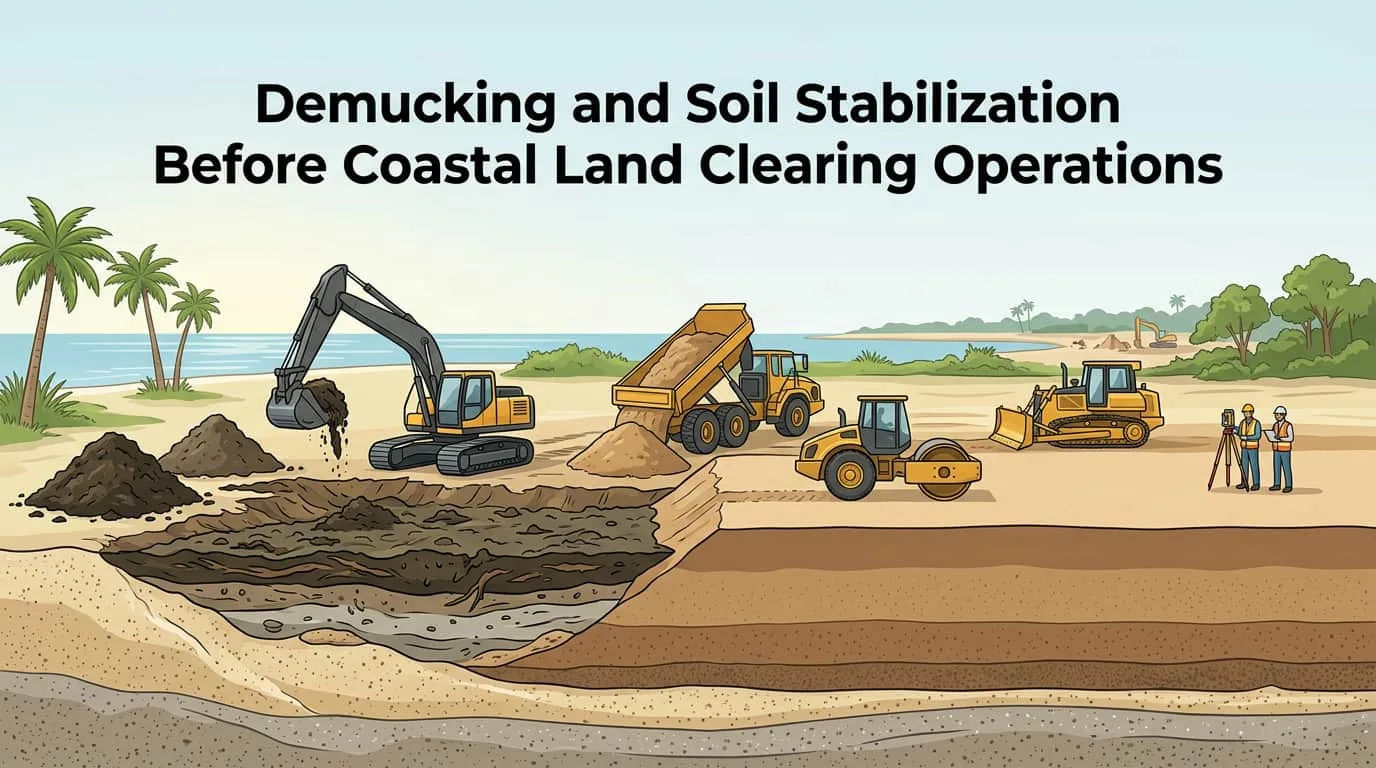
Demucking removes soft, organic-rich soils that lack bearing capacity to prevent future foundation settlement. We excavate this unstable material down to a solid stratum, haul it off-site, and replace it with structural fill dirt. This process creates a solid base for your entire development.
Based on the commercial site development projects we completed last year, excavating and hauling off muck typically costs between $15 and $30 per cubic yard. While this adds to your initial site prep budget, it saves you from massive liability later. Fixing a cracked foundation on a commercial building easily exceeds $100,000.
During commercial land clearing Flagler Beach, Florida, we identify these problematic soils early. We look for visual cues like dark coloring and spongy textures. We then rely on detailed soil boring reports to determine the exact depth of the required excavation. For sites with a high water table, we also implement aggressive dewatering strategies to keep the excavation trench dry while we remove the bad dirt.
How Do You Engineer Endurance With Soil Stabilization?
Soil stabilization improves the physical properties of your existing ground to increase strength, reduce permeability, and control volume changes. Once we remove the unstable muck, we reinforce the remaining soil to support heavy structural loads and withstand dynamic coastal weather.
For most coastal Florida sites, we rely on mechanical stabilization. We blend granular materials into the native sand and use heavy vibratory rollers to achieve maximum compaction. We test the soil to ensure it hits 95% Modified Proctor density. Occasionally the native soil requires chemical stabilization. In those specific cases, we mix in lime or cement to bind the soil particles together and create a rigid subgrade.
We also install high-strength geotextile fabrics to separate the soft subgrade from our clean structural fill. This prevents the good dirt from sinking into the bad dirt over time. We pair these geotechnical techniques with proper grading and drainage to keep standing water away from your newly stabilized foundation.
How Do Demucking and Stabilization Work Together?
These two processes work in a strict sequence. We first remove the unstable organic matter, then we backfill and mechanically stabilize the new material. You cannot successfully stabilize a site if you leave a thick layer of compressible muck trapped underneath your fill dirt.
The sequence starts with a thorough geotechnical investigation. You need to know exactly what sits beneath the surface near places like Bulow Creek. Once we understand the soil profile, we mobilize our heavy equipment. We perform our land clearing and demucking simultaneously. After we reach a stable stratum of earth, we bring in clean fill in 12-inch lifts.
We compact each lift to meet strict engineering density requirements. We let the site settle for 30 to 60 days, monitoring it closely to confirm it meets all load-bearing specifications. This methodical approach guarantees your commercial site remains stable for decades.
Navigating Environmental Compliance and Erosion Control
Florida regulates coastal development heavily to protect our delicate wetlands and estuaries. Moving thousands of yards of dirt creates a high risk for sediment runoff. You must implement strict erosion control measures during every phase of your site preparation.
We install heavy-duty silt fences and turbidity barriers before we move a single bucket of dirt. This keeps loose sediment out of adjacent water bodies. Working near the coast also requires handling a complex web of local and state permitting. You need contractors who understand Flagler County and Volusia County code requirements. We keep your project compliant so you avoid costly fines and local project shutdowns.
Handling the water table safely also requires specific permits for dewatering operations. We pump the groundwater into approved retention areas, allowing the sediment to settle before the water returns to the natural aquifer.
The Bottom Line on Coastal Site Prep
You can't cut corners on dirt. Proper demucking and soil stabilization protect your investment and keep your structures safe over the long term. When you handle the geotechnical challenges correctly from day one, you eliminate the risk of sinking foundations and cracked walls.
Partner with an experienced team that understands the exact soil conditions of the Florida coast. Trust the experts at Rogers Landworks to handle your next project with precision. If you require professional land clearing Flagler Beach, Florida, we have the heavy equipment and local knowledge to get the job done right. Reach out to Rogers Landworks at (386) 334-4579 to discuss your commercial site development needs today.