Ever tried to dig a hole near the Halifax River only to have the sand slide right back in? If you work in development, you know that Florida's terrain is deceptive. It looks flat and easy, but between the sandy soil, high water tables, and dense palmetto roots, it requires a specific strategy.
Choosing the right machinery isn't just about horsepower; it's about flotation and precision. In Ormond Beach, where you might be working on a sandy ridge one day and near a wetland the next, your equipment list needs to be versatile. Using the wrong gear can delay a project by weeks, and in this industry, time is money.
Which Dozers Handle Florida Sand Best?
For sandy Florida soil, you need bulldozers equipped with Low Ground Pressure (LGP) tracks to prevent sinking and ensure efficient grading. Standard tracks often dig in too deep, causing the machine to bog down and struggle for traction. LGP tracks are wider, distributing the machine's weight over a larger surface area, which allows the dozer to "float" on top of the sand rather than churning through it.
When we tackle site development in Ormond Beach, Florida, we rely heavily on medium-sized dozers like the D6 class. They offer the perfect balance of power for pushing heavy loads of fill dirt while remaining nimble enough for finish work.
The Role of Land Clearing
Before any grading happens, you have to clear the lot. Effective land clearing is the first step in any successful project. In our area, that often means battling dense scrub oak and saw palmetto. A dozer with a root rake is essential here. We typically see that using a root rake instead of a standard blade removes 95% of the subsurface root systems in the first pass, preventing future settling issues.
Why Are Excavators Crucial for Coastal Projects?
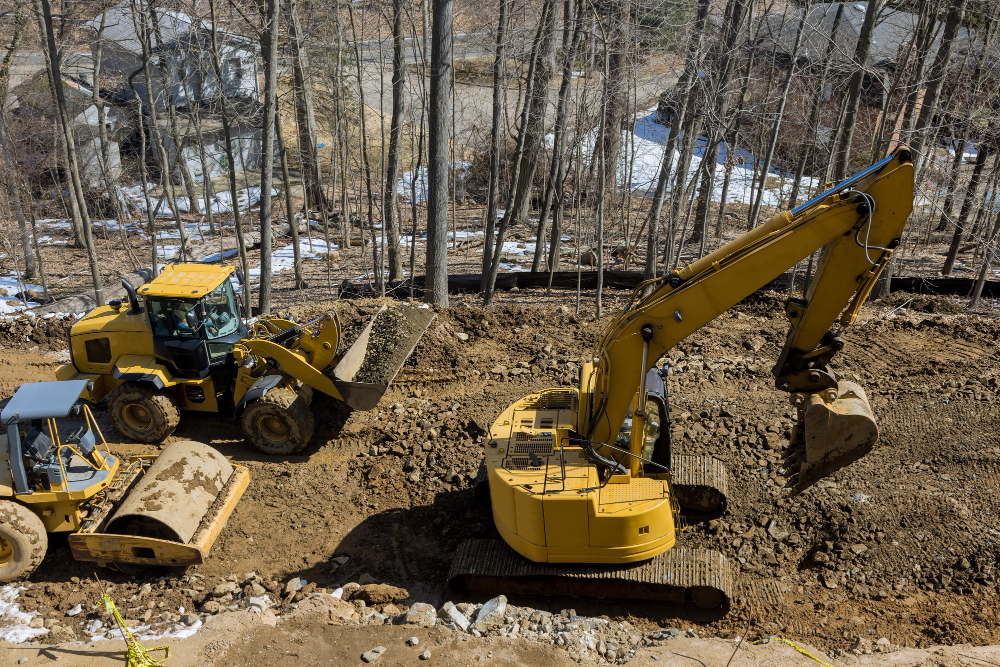
Excavators are critical for managing Florida's high water table, digging retention ponds, and trenching for utilities in wet conditions. Unlike wheel-based machines that can get stuck in the mud, track excavators provide the stability needed to work near the water's edge or in low-lying areas.
If you're developing near the Tomoka River or similar marshy areas, an excavator with a long-reach boom is a game-changer. It allows operators to dredge or shape banks from a safe distance without compromising the bank's stability.
In our experience, a 20-to-30-ton excavator is the workhorse for site development in Ormond Beach, Florida. These machines are strong enough to lift heavy concrete storm structures but compact enough to maneuver around trees that need to be preserved. We recently saw a project where utilizing the right-sized excavator reduced the pipe installation time by 20% because the machine could swing within a tighter radius, avoiding the need to reposition constantly.
How Does Grading Technology Save Time?
GPS-guided grading equipment cuts project timelines by eliminating the need for constant manual staking and grade checking. By integrating GPS systems into motor graders and dozers, operators can achieve grade accuracy within a fraction of an inch on the first pass.
This precision is vital for grading and drainage. In Florida, where we deal with sudden, heavy downpours, the drainage plan must be executed perfectly. If the grade is off by even an inch, you end up with standing water, which creates breeding grounds for mosquitoes and leads to inspection failures.
The Cost of Precision
While GPS systems require an upfront investment—often adding $20,000 to $30,000 to the cost of a machine—the return on investment is rapid. According to industry data, using 3D machine control can improve grading productivity by up to 50%. On a 10-acre site, that efficiency translates to saving days of machine time and thousands of dollars in fuel and operator wages.
What Loaders Work Best in Soft Soil?
Track loaders are generally more effective than wheel loaders for site work in Ormond Beach due to their superior traction in loose sand and mud. While wheel loaders are faster on hard surfaces, they tend to spin their tires in the sugar sand common in our area, wasting fuel and damaging the graded surface.
Compact Track Loaders (CTLs) are incredibly versatile for site development in Ormond Beach, Florida. They can handle attachments ranging from grapple buckets for moving debris to augers for drilling fence posts. For smaller residential pads or tight commercial lots off Granada Boulevard, a CTL can move 40-50 cubic yards of material per hour, making it highly efficient for final dressing and cleanup.
How Do You Maintain Equipment in Salt Air?
To prevent rapid corrosion from salt air, equipment working beachside requires daily freshwater washdowns and frequent application of specialized protective coatings. The salt spray from the Atlantic doesn't just rust the body panels; it attacks electrical connections and hydraulic cylinder rods.
We find that greasing the machine's pivot points daily—rather than the standard weekly schedule—is necessary when working east of I-95. The sand acts as a grinding compound, wearing out pins and bushings twice as fast as in other environments. Replacing a set of pins and bushings on an excavator can cost upwards of $3,000 to $5,000, so that extra grease is cheap insurance.
Minimizing Impact with the Right Gear
Using appropriately sized equipment and establishing clear limits of disturbance helps protect the local ecosystem during development. Instead of clearing a site wall-to-wall, smart developers use machinery that can work selectively.
For example, using a forestry mulcher instead of a bulldozer for the initial underbrush removal preserves the topsoil layer and keeps the root structures of "keeper trees" intact. This approach reduces erosion runoff during the rainy season. It’s a practice we see gaining traction in eco-conscious developments near the Loop, where maintaining the natural canopy is a priority for buyers.
The Bottom Line on Site Equipment
Success in Florida development comes down to respecting the land and using the tools that work with the terrain, not against it. From LGP dozers that float over the sand to GPS graders that ensure perfect drainage, the right fleet makes the difference between a project that stalls and one that sells.
As we look toward the future of development in Volusia County, integrating technology with rugged, Florida-proven iron will continue to be the standard for efficiency.
Need Help With Your Next Project?
Don't let Florida's challenging terrain slow you down. Contact Rogers Landworks at (386) 334-4579 today. We have the experience and the equipment to get your site ready for construction.