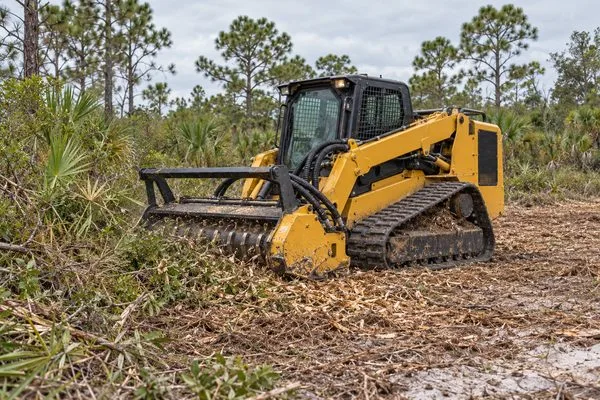
On-site grinding usually cuts land clearing debris costs by shrinking the volume that has to leave the site, which means fewer trucks, fewer loads, and less tipping. Hauling still makes sense when the material cannot be ground, the site is too small to process on, or the debris has to go anyway.
At Rogers Landworks, we run Peterson grinders and Volvo equipment out of Bunnell and handle processing, haul-off, and disposal as one turnkey operation. To get a number for your parcel, reach out to our team or call (386) 334-4579.
What drives land clearing debris costs in Flagler Beach?
Debris cost comes down to volume and distance. The more loose material you move, and the farther it has to go, the more you pay in trucking time and disposal fees.
Cleared vegetation is bulky. Pines, oaks, palmetto, and brush take up far more space as whole debris than the same material does once it is processed. Every load hauled off loose is a load of mostly air.
Location adds to it. Lots near A1A and the beachside streets are often tight, with little staging room and limited access for big trucks. Larger parcels along the State Road 100 corridor toward Palm Coast and Bunnell may have more space, but also more material, and the haul to a disposal site adds time every trip.
Then there are tipping charges, the fees a disposal facility charges per load or per ton. They vary by facility and material, so it is worth getting current rates before you budget. Together, trucking hours and tipping fees are where most debris budgets get away from builders.
How does on-site grinding reduce haul-off costs?
Grinding turns bulky cleared material into processed mulch right on the parcel. That shrinks the volume significantly, so far fewer truckloads are needed, and in some cases the material never has to leave at all.
Our grinding is a turnkey service. We process the raw material on site, and when haul-off is needed, we handle that and disposal too, so you are not coordinating three different vendors. We recycle material whenever possible.
Processed material can also be useful on the project itself, depending on your plans and engineering requirements. Builders sometimes keep some of it for erosion control, temporary site use, or landscape beds instead of paying to haul it away and buy material back later.
Grinding also helps the schedule. Instead of waiting on a steady stream of trucks to clear piles, the material is processed in place and the site opens up faster for the next phase of work. See how our on-site grinding service works.
When is hauling still the smarter call?
Hauling makes more sense when grinding is not practical or does not save enough to justify setting up. The right answer depends on the site, the material, and the schedule.
Small infill lots are the most common example. If there is not enough room to set up a grinder and stage processed material safely, hauling the debris out may be simpler.
Some debris also cannot be ground into usable mulch. Material mixed with soil, rock, concrete, or construction waste usually needs to be hauled. And if the plans have no use for mulch on site, part of the processed material may still need to leave.
When trucking is the right call, the goal is efficient loads and a reliable schedule. We handle debris haul-off from land clearing operations with walking floor trucks, along with flat-bed and landoll transport for equipment. Learn more about our trucking and heavy haul services.
How do site conditions change the math?
Site access can matter as much as volume. A parcel with one narrow entrance can turn into a traffic jam when haul trucks, delivery trucks, and equipment all need to move at once.
A builder once told us he needed cleared material and debris hauled away as soon as possible. While we were talking on site, a delivery truck had to back out because another truck could not get in.
We pointed out the potential bottleneck and suggested on-site grinding to cut down the traffic going in and out. Fewer haul trucks meant more room for the deliveries and crews the job actually depended on.
Other conditions matter too. Wet ground after summer storms can slow trucks and rut the site. Neighboring homes close to the property line may limit when and where heavy equipment can work. A good plan accounts for all of it before the first tree comes down, not after.
How do you choose the right approach for your site?
Start with a walk-through. Seeing the parcel, the vegetation, the access points, and your build schedule is the fastest way to tell whether grinding, hauling, or a mix of both will cost less.
Bring your site plan if you have one, along with your timeline and any notes on what material you might want to keep on site. That helps us estimate volume, plan staging, and compare the cost of processing against the cost of trucking it out.
Many projects end up using both. Grind what can be processed, keep what is useful, and haul only what has to go. That combination often keeps both the budget and the schedule on track from clearing through final grade.
Ready to plan land clearing on your Flagler Beach parcel? Contact Rogers Landworks or call (386) 334-4579 for a free walk-through and estimate on your specific site.